


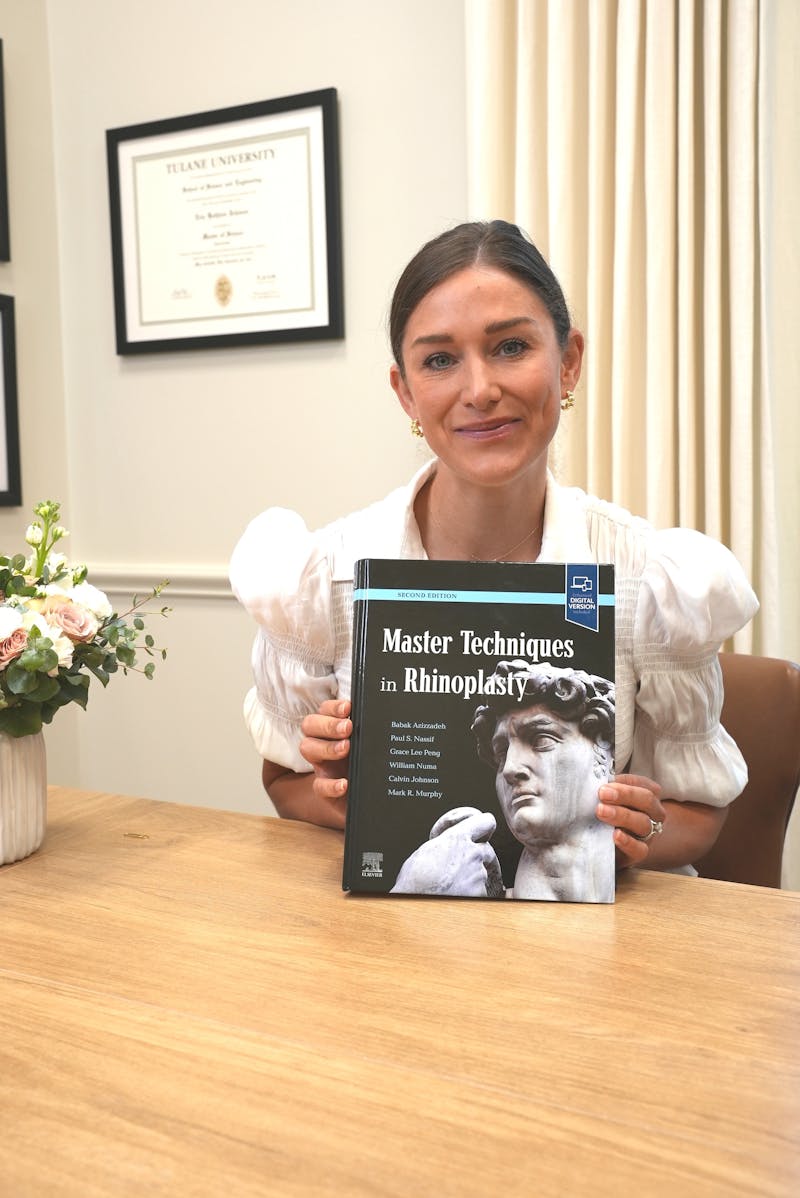
At the Buckingham Center for Facial Plastic Surgery, rhinoplasty is a discipline we've dedicated ourselves to mastering. Our surgeons are fellowship-trained, double board-certified facial plastic surgeons who operate exclusively on the face. That commitment recently reached a significant milestone: Dr. Erin Smith has co-authored a chapter in Master Techniques in Rhinoplasty, Second Edition, a peer-reviewed surgical textbook that serves as the current gold standard in rhinoplasty knowledge. Her chapter addresses the saddle nose deformity, which is one of the most technically demanding presentations in nasal surgery.
In this blog, we'll explore what that contribution means, what the saddle nose deformity is, how it's treated, and why published expertise like Dr. Smith's translates directly into better outcomes for patients considering rhinoplasty.
About Master Techniques in Rhinoplasty, Second Edition
Master Techniques in Rhinoplasty is a comprehensive surgical reference text authored and edited by some of the most respected rhinoplasty surgeons in the world. The second edition reflects advances in technique, outcomes data, and anatomical understanding that have reshaped how surgeons approach nasal surgery in recent years.
Inclusion as a contributing author is not a credential easily earned; it requires both deep clinical expertise and the ability to synthesize that expertise for a peer audience of fellow surgeons.
Dr. Smith's Chapter: The Saddle Nose Deformity
Dr. Smith's chapter opens with a clear-eyed summary of what makes this deformity both distinctive and demanding:
"The saddle nose deformity presents both aesthetic and functional challenges and is among the more complex problems in rhinoplasty. First described in 1887, the term saddle nose is derived from the appearance of the nose on lateral view in which the dorsal curve depression resembles a horse's saddle."
Though relatively uncommon, the saddle nose deformity demands a high level of surgical skill because it involves a loss of structural integrity rather than merely cosmetic irregularity. That loss, a reduction in dorsal height along the cartilaginous or bony vault, can stem from a range of causes:
-
Congenital conditions, such as Binder syndrome, a developmental anomaly affecting midface growth
-
Systemic disease, including granulomatosis with polyangiitis (formerly Wegener's granulomatosis), an autoimmune condition that can destroy cartilaginous tissue
-
Acquired pathologies like trauma, septal hematoma, prior septorhinoplasty, substance abuse—particularly intranasal substance use, which causes progressive tissue destruction—and infection.
Because the deformity can affect the cartilaginous vault, the bony vault, or both, the cause is as surgically significant as the presentation itself. Each zone demands its own reconstructive strategy, and a condition that is still active—an autoimmune disease, for instance—requires a fundamentally different approach than one with a resolved etiology like trauma.
Correction typically relies on structural grafts to restore dorsal height and projection. Graft selection depends on the extent of the deficiency:
-
Autologous cartilage harvested from the patient's own septum, ear, or rib remains the gold standard in complex nasal reconstruction due to its biocompatibility and longevity
-
Costal cartilage for cases requiring substantial volume and structural support
-
Alloplastic implants in select, carefully considered cases
The goal throughout is a nose that looks untouched, not merely repaired.
Why Published Expertise Matters for Patients
There is a meaningful difference between a surgeon who performs a procedure and a surgeon who has contributed to its academic literature.
Writing for a peer-reviewed surgical textbook requires surgeons to evaluate their techniques, critically review evidence, and clearly communicate their reasoning to colleagues who uphold high standards.
For patients, this means:
-
Your surgeon has been tested beyond the operating room: Dr. Smith's chapter wasn't written for a general audience; it was written for other fellowship-trained rhinoplasty surgeons. That level of scrutiny sharpens clinical thinking, directly benefiting patient outcomes.
-
Your surgeon engages with the full scope of the field: Saddle nose deformity intersects with reconstructive surgery, trauma care, autoimmune medicine, and aesthetic surgery. A surgeon who has studied and published on this complexity brings a broader clinical perspective to every rhinoplasty consultation.
-
Your surgeon is part of the conversation that shapes best practices: Surgical excellence isn't static. It evolves through exactly the kind of contribution Dr. Smith has made. Our patients benefit from that evolution in real time.
Rhinoplasty at the Buckingham Center
Dr. Smith is joined at the Buckingham Center by Dr. Edward Buckingham and Dr. Hudson Frey, each fellowship-trained, board-certified facial plastic surgeon. Our practice has served Austin for over 20 years with a singular focus: the face. Every surgery we perform, every technique we refine, every publication we contribute to is in service of one discipline.
That focus is also why we attract patients from across the country and internationally. We welcome traveling patients and are happy to coordinate consultations, surgical timing, and postoperative care to accommodate those coming from outside Austin.
If you're exploring rhinoplasty, whether you've been told you have a complex nasal concern or simply want to understand your options, we invite you to speak with one of our surgeons directly. Dr. Smith, Dr. Buckingham, and Dr. Frey each bring fellowship-level training and a commitment to natural, lasting results that respect who you are.